Workday gives HR teams a strong foundation for managing workforce data and everyday operations. But compliant, compassionate employee separations require more than a termination workflow. They demand carefully coordinated severance agreements, OWBPA disclosures when necessary, and tracking of review and revocation periods.
A layoff, restructuring, or individual separation that includes severance comes with legal requirements. For example, severance agreements must not waive certain employee rights protected by federal and state law. Employees 40 and older need documents that comply with the Age Discrimination in Employment Act (ADEA) and the Older Workers Benefit Protection Act (OWBPA), including the legally specified review and revocation periods.
This guide covers common severance requirements, where gaps can appear when Workday data is exported into spreadsheets and documents, and how to manage severance and OWBPA compliance while keeping Workday as your system of record.
Using Onwards HR and Workday: The short version
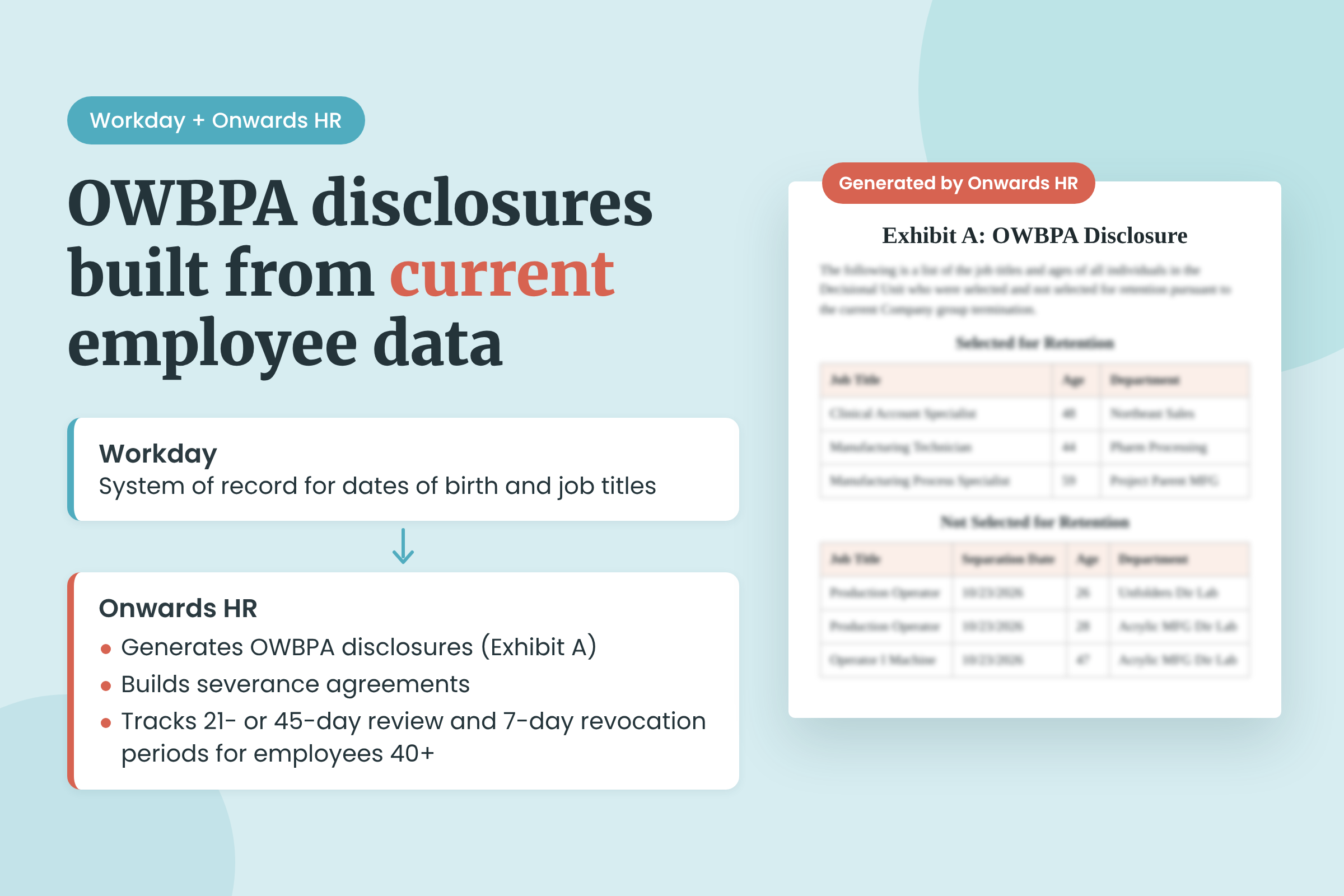
Workday is the system of record for the employee data OWBPA compliance depends on, such as dates of birth and job titles. Onwards HR integrates with Workday to generate OWBPA disclosures (Exhibit A), build severance agreements, and track the 21- or 45-day review period and 7-day revocation period for each employee age 40 or older. Your team keeps using Workday as it does today.
Onwards HR was designed to help employers manage restructures and workforce reductions with ease. Using Onwards HR technology, employers can create event-specific employee pools that align with the business justification and selection criteria. From there, employers can use the employee pool functionality to assign employees as considered for or impacted by layoff. This makes it especially easy for employers to generate an OWBPA disclosure that accurately reflects who was considered and selected for a specific reduction event.
What is OWBPA?
The Older Workers Benefit Protection Act (OWBPA), a 1990 amendment to the ADEA codified at 29 U.S.C. § 626(f), sets the conditions under which an employee age 40 or older can knowingly and voluntarily waive age discrimination claims in a severance or separation agreement. If an agreement doesn't meet the conditions specified by OWBPA, the waiver of age claims may not be enforceable, which can create legal risk for employers even after paying severance.
Can you manage OWBPA compliance in Workday?
Workday typically holds the employee data that informs OWBPA compliance, including dates of birth and job titles. Whether it also produces OWBPA disclosures and tracks review periods depends on how your organization has configured it.
But if your setup doesn't produce OWBPA disclosures or track waiver review periods, those steps often require the use of supporting spreadsheets and calendars. That’s where Onwards HR can work with your existing technology, such as Workday, to let teams generate OWBPA disclosures (sometimes called Exhibit A, the ADEA attachment, or the OWBPA chart), help ensure the legally required waiver criteria are met, and track mandatory review and revocation periods automatically.
From manual data to OWBPA compliance automation: Integrating Workday with Onwards HR
Workday has the data you need. Without a connected compliance tool, though, human intervention is required. Someone in HR must pull the right report, know what to do with it and when, and catch any changes before agreements go out. For example, an employee who was 39 when the Workday report was run may turn 40 before agreements are distributed. Now, not only is that employee missing the necessary information, but employers risk providing an inaccurate OWBPA disclosure chart to all employees who require it. An innocent error like this can lead to age discrimination waivers that may not hold up under scrutiny. Each manual handoff adds another chance for this kind of error.
Integrating Workday with Onwards HR closes that gap. Onwards HR uses current Workday data, so disclosures and agreements reflect each employee's status when they're generated, not when a report was exported. This also makes it easy for employers to regenerate OWBPA disclosures until the moment of distribution, ensuring accuracy of information.
Workday stays your system of record. Onwards HR handles the specialized separation work alongside it, so HR and legal teams spend less time assembling documents and more time supporting the employees who are leaving.
“[Onwards HR] allows us to focus more on the employee experience in their exit versus the administration. The severance is calculating automatically within the system and creates the severance agreements dynamically. It’s been powerful to use for both Reduction In Force and Individual Separation Agreements.”
| OWBPA Requirements | Workday + Onwards HR |
|---|---|
| Provide waivers to protected employees | Automatic: OWBPA disclosures generated for protected employees from synced Workday data |
| Ensure waivers are valid and fulfill OWBPA’s mandated waiver criteria | Built-in support for all OWBPA waiver criteria |
| Adhere to legally required waiver review time periods | Automatic tracking of required review and revocation periods for each employee |
| Identify employees age 40 or older who need ADEA/OWBPA-compliant waivers | Uses up-to-date Workday data to support age-based compliance and automatically generates waivers for protected employees |
How do Workday and Onwards HR work together to manage severance calculations and packages?
Working alongside Workday, Onwards HR’s configurable severance automation tools simplify each separation while following your corporate policy and applicable employment laws. Providing offboarding benefits leads to reduced legal risk, improved morale, and brand preservation. Plus, by automating administrative tasks, your team can spend more time focused on the business.
With Workday connected to Onwards HR, teams can:
Manage severance policies by entity, country, union, and other factors
Model severance scenarios to compare cost and approach before decisions are final
Review a current snapshot of severance pay totals throughout each phase of the separation process
Automatically recalculate severance when changes occur, such as updated timelines or internal transfers
Manually override severance pay calculations when exceptions arise
Why integrate Workday with Onwards HR?
Every compliant separation starts with accurate data. Onwards HR integrates with Workday, which remains your system of record. Alongside Workday, Onwards HR provides a purpose-built solution for managing the ins and outs of a compliant, compassionate severance experience.
Working from current Workday data helps companies:
Avoid severance pay mistakes, especially those resulting from changes in employee status, pay rate, or work anniversaries
Better adhere to U.S. federal and state separation laws, including the WARN Act, mini-WARN Acts, and state-specific offboarding requirements
Consistently apply corporate policies based on current employee data
When Workday and your offboarding process are disconnected, a pay change, transfer, or birthday between the data pull and the separation date can put the wrong amount or the wrong waiver in front of an employee.
Don’t make headlines. Make a great last impression.
OWBPA and severance compliance in Workday: Your top questions answered
Does Onwards HR replace Workday?
No. Onwards HR integrates with your Workday HCM, and your team keeps using Workday as it does today. Workday stays your system of record, while Onwards HR helps your team manage severance agreements, OWBPA disclosures, and state separation notices using up-to-date Workday data. Learn more about Onwards HR system integrations.
What information has to be included in an OWBPA group disclosure?
The group of employees covered by the program, the eligibility factors and time limits, and the job titles and ages of employees selected and not selected.
Does Workday generate OWBPA disclosures?
Workday stores the employee data an OWBPA disclosure needs, but many teams build the disclosure itself outside Workday. Depending on the size of the separation event, the list of considered employees could be in the thousands, creating significant opportunity for error if created manually. Onwards HR integrates with Workday and generates OWBPA disclosures for protected employees automatically.
What happens if an OWBPA disclosure is wrong or missing?
If a required disclosure is missing or inaccurate, the employee’s waiver of age discrimination claims may not be considered knowing and voluntary, so the employee could still bring an ADEA claim after accepting severance. Employers generally can’t require an employee to return the severance before challenging the waiver.
How long does an employee have to consider a severance agreement under OWBPA?
Employees have at least 21 days for an individual separation, or 45 days when the offer is part of a group layoff or exit incentive program. Under OWBPA, the employee then has 7 days after signing to revoke. Since Onwards HR is a specialized offboarding tool, it can also handle exceptions, such as Minnesota’s 15-day revocation period for severance agreements.
Can Onwards HR also help with WARN Act compliance?
Yes. Onwards HR evaluates whether the U.S. WARN Act and state mini-WARN laws apply to a reduction in force, helps identify potential violations, and delivers compliant notices when they’re required.
What about state separation notices?
Nearly half of U.S. states have their own separation notice requirements, including distribution of information related to filing for unemployment insurance. Onwards HR generates the right notice for each employee based on their location and delivers it within the state’s required time frame.
This guide is for general information and isn’t legal advice. Workday is a registered trademark of Workday, Inc.