Employee Offboarding Best Practices: 4 Ways to Support Departing Employees

Offboarding is a critical but often overlooked part of the employee lifecycle. Learn four employee offboarding best practices that help organizations stay compliant, protect their employer brand, and support departing employees during times of transition.
Why Compassionate Employee Offboarding Matters
Offboarding is often treated as an administrative process focused primarily on paperwork and logistics. But how organizations manage employee departures has lasting implications on employer reputation, future hiring, and the relationships former employees may have with the company as customers, advocates, or even future colleagues.
Handled thoughtfully, the offboarding process can protect the organization, support departing employees, and reinforce a culture of respect during times of transition.
So, why does compassion matter so much during employee offboarding?
It’s the right thing to do. Period.
People are watching. This includes current and prospective employees, stakeholders and customers.
Goodbyes aren’t final. Since 2018, boomerang employees make up about 31% of new hires on average, according to data from ADP.
The following best practices can help organizations approach offboarding with both compassion and compliance.
Quick Employee Offboarding Checklist
A compassionate employee offboarding process should include these steps:
Ensure compliance with federal and state separation laws
Provide fair severance pay
Offer continued benefits (COBRA or similar)
Provide outplacement services
Communicate next steps clearly
#1: Ensure Compliance with Offboarding Laws
Employers must ensure compliance with federal, state, and local labor laws when managing employee separations.
Though it’s not the most exciting element of offboarding, comply with the law. There are (literally) countless federal, state, and local labor and employment laws that employers must follow.
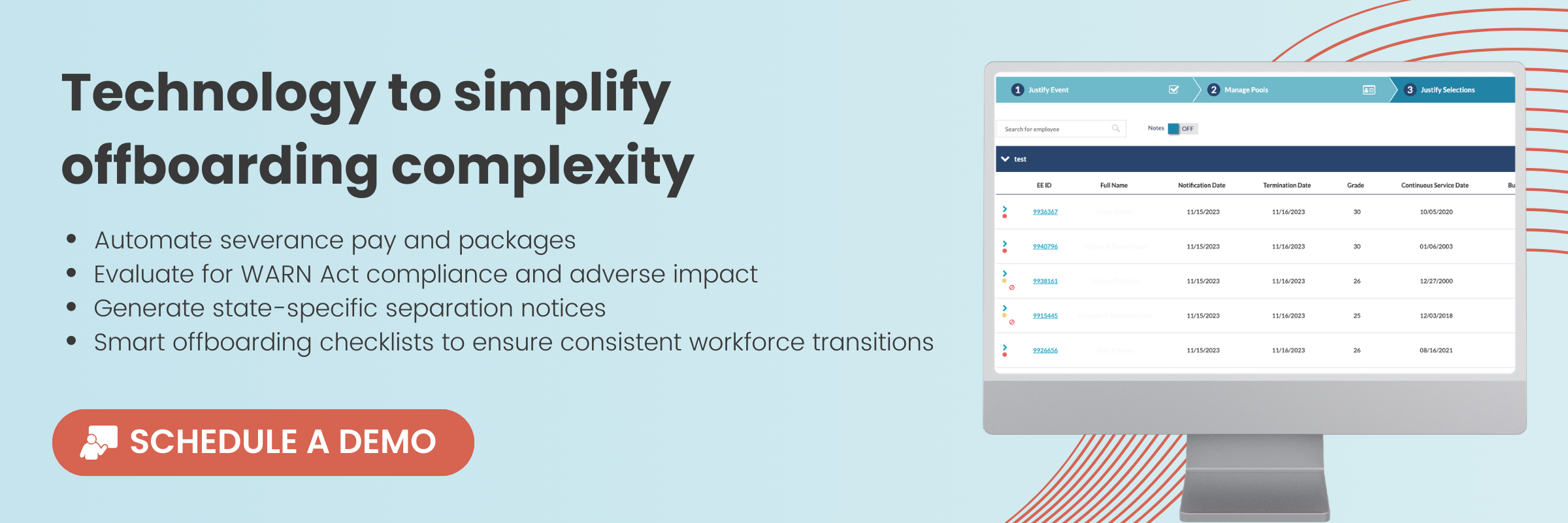
For example, nearly half of U.S. states have their own unique separation notice requirements, most of which are related to unemployment insurance. Creating and distributing proper documentation is a particularly cumbersome process for employers—unless they use offboarding technology like Onwards HR.
Employers must also comply with the federal WARN Act and its state-specific counterparts. WARN Act laws require employers to provide advance notice in certain situations, most notably mass layoffs and plant closings. These laws give employers time to search for new work, so adhering to the law is a MUST if you want to demonstrate that you care.
During offboarding, compliance is compassion.
#2: Provide Fair Severance Pay
Providing fair severance pay helps organizations support employees during workforce reductions, while also reducing legal and reputational risks.
When employees lose their jobs through workforce reductions, they’re often asked this question: “Did you get severance?” And the answer speaks volumes.
Severance pay provides vital support to transitioning employees and, in some cases, helps companies comply with labor and employment laws. On average, employers provide one to two weeks of severance pay per year of service. It’s also common for executives to receive more generous severance pay based on their compensation package. Managing severance calculations can be complex, which is why tools like the rules-based severance calculator from Onwards HR can help simplify the process.
Even if severance pay isn’t required, it’s a professional and caring gesture. Plus, it reduces legal risk, especially when severance is provided in exchange for a valid release of claims.
Help your employees through a challenging time by providing severance pay.
HR Expert Insights
"How you let people go can easily make headlines and impact whether or not people want to support your business or work for your organization in the future. Your severance practices not only ensure you treat employees with care; they can be a competitive advantage."
—Lindsay Witcher, Global Managing Director for Randstad RiseSmart, Randstad Enterprise
#3: Offer Continued Benefits After Separation
Continuing employee benefits after separation can help reduce financial and healthcare uncertainty during a difficult transition.
Benefits should be a primary consideration when offboarding employees. The most obvious of these is the Consolidated Omnibus Budget Reconciliation Act (COBRA), which requires employers to continue employee health insurance plans for at least 18 months after separation.
Generally, the cost of COBRA is paid by employees, but some of the more generous employers contribute toward these costs for a set period following separation—or until impacted employees find new employment.
Employers can also offer continuation of other benefits for a set period of time to ease the transition.
Lastly, if an employer is in a state that doesn’t mandate payout of unused vacation time, that’s another good way to help employees financially.
#4: Provide Outplacement Services
Outplacement services help departing employees transition into new roles more quickly while protecting the employer’s reputation.
Globally, 38% of employers offer outplacement services, according to a study by Randstad RiseSmart. Here’s a look at some of the benefits of outplacement services.
Benefits for Employees
Career coaching
Resume support
Interview prep
Job leads
Networking opportunities
Talent development
Benefits for Employers
Improves employee morale (and builds comfort with existing employees)
Reduces legal risks associated with separations
Lowers the company’s unemployment costs
Protects your brand reputation
Outplacement services help employees find their new beginnings 60% faster than the market average, based on Randstad RiseSmart data. What better way to support transitioning employees than to help them land on their feet.
Additional Considerations
Depending on the circumstances, some companies can offer additional support through nontraditional means—like allowing affected employees to use the company gym, continued use of a company vehicle, or letting them keep certain company property.
Some employers also provide additional resources, like clear steps to obtain job references or other ways to simplify the overwhelming process of searching for employment.
Think outside the box! What can your company offer that’s unique? How can you ensure departing employees are best positioned for what comes next?
Summary
A strong employee offboarding process is about more than paperwork. When companies prioritize compliance, severance support, continued benefits, and outplacement services, they demonstrate compassion and protect their reputation.
Organizations that invest in thoughtful offboarding practices often see stronger employer branding, reduced legal risk, and even the return of boomerang employees.